| Movies/TV | |||
| "Blackout"
|
"FRONTLINE and The New York Times join forces to investigate the story behind California's energy crisis. 'Blackout' examines whether power companies and energy trading companies capitalized on deregulation to make huge profits and explores what actions the new Bush administration will take to address what the president is now calling a national crisis." Check your local listings for time and station information, or visit www.pbs.org to learn more or purchase a video copy of the telecast. | ||
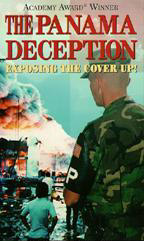
| "The Panama Deception"
To order the video for Call 1.800.832.4369 or write to: The Empowerment
Project |
Winner - 1993 Academy Award, Best
Documentary Feature "Barbara Trent is an Oscar® winning filmmaker, former welfare mother, seasoned activist, and trail blazer for change. She has publicly exposed criminal activities in the White House, Pentagon, and CIA; and has been the target of at least three FBI counter intelligence operations. Her personal story of courage risk and achievement, starting in the 1960s is inspiring to many. The Panama Deception documents the untold story of the December 1989 U.S. invasion of Panama; the events which led to it; the excessive force used; the enormity of the death and destruction; and the devastating aftermath. The Panama Deception uncovers the real reasons for this internationally condemned attack, presenting a view of the invasion which widely differs from that portrayed by the U.S. media and exposes how the U.S. government and the mainstream media suppressed information about this foreign policy disaster. The Panama Deception includes never before seen footage of the invasion and its aftermath, as well as interviews with both invasion proponents like Gen. Maxwell Thurman, Panamanian President Endara and Pentagon spokesperson Pete Williams, and opponents like U.S. Representative Charles Rangel (D-NY.), Panamanian human rights workers Olga Mejia and Isabel Corro and former Panamanian diplomat Humberto Brown. Network news clips and media critics contribute to a staggering analysis of media control and self censorship relevant to any news coverage today, particularly during times of war."- The Empowerment Project |
||
| "Long Day's Journey Into Night" | For over forty years, South Africa was
governed by the most notorious system of racial domination since Nazi Germany. When it
finally collapsed, many of those who had enforced apartheid's rule - as well as many of
those who resisted it - sought amnesty for their crimes. The victims wanted justice. As a
political compromise, the Truth & Reconciliation Commission (TRC) was formed. Amnesty
would be considered on a case-by-case basis - in exchange for the truth. Over 22,000
victims and families told their stories to the TRC. Some 7,000 perpetrators, from all
political parties, applied for amnesty. These are four of their stories. This is the practice of what Nobel Laureate Bishop Desmond Tutu calls, "Restorative Justice, as opposed to Retributive Justice" in action. Exceedingly profound, images are very graphic, I recommend no young kids in the room, but when they're old enough, this is one they SHOULD see. |
||
|
"Enter The Workers"
To get a copy of the film, please visit: To find a Citgo gas station near you, please visit:
|
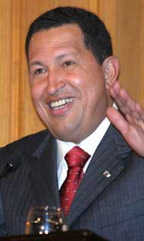
"In the US, Citgo is an oil refiner and marketer is about the same as any of the others on the environment and most of the other things oil companies do. But a new film in Los Angeles produced by Global Women's Strike, called "Enter The Workers" about workers at Venezuela's state oil company, PdVSA, (which supplies Citgo), shows a very different aspect of the story. The documentary, which was first shown at the East Side Cafe in Alhambra/LA on as part of a benefit for the Million Workers March in Washington, shows the extent of effort Venezuela's workers went through to produce oil in the face of a brutal lockout by management, which called an illegal strike in 2002-2003. Unlike management, the oil workers wanted no part of that strike, because it was done explicitly to damage the Venezuelan economy and overthrow President Hugo Chavez. The net result was a cutoff of oil to all of Venezuela's buyers (which included the US) in the first part of 2003. This, along with the run-up to the Iraq War, knocked oil prices skyward from $1.30 at the pump to $1.80 or so. It was Venezuela's oil management's gift to the US drivers, it seems. But these locked out Venezuelan oil workers had very little to fight back with. They inherited the abandoned oil colossus at the end of the strike, which eventually ridded the company of 18,000 managers who walked out. But on their way out, management damaged computers, stole software, messed up refinery configurations for the production of fuel, sabotaged gas stations, and made at least 19 efforts to blow up or disrupt oil pipelines. The workers grouped together and supported each other in guarding the company so that they could produce petroleum for the country and for the other countries Venezuela supplies. And in turn get cash which would be used for social programs. These workers' ultimate triumph was to get their company producing again without management, its expertise or its information technology. They succeeded and learned they didn't need management. Today Venezuela produces as much oil as it did before the 18,000 PdVSA managers abandoned the job. For us in the U.S., their actions directly keep oil prices here in the U.S. from rising any higher than they already are as a result of Bush's war. Other than the managers' strike in 2002-2003, Venezuela has never disrupted the supply of oil to the U.S. The best way to make a statement about it in solidarity with Venezuela's tenacious workers, and everything they went through to get the supply out, is to buy Venezuela's own gasoline - which you can get at Citgo, which is owned by the Venezuelan government. Bush and his oil cronies don't get a drop of its profits. Money you pay to Citgo goes primarily to Venezuela -- not Saudi Arabia or the Middle East. There are 14,000 Citgo gas stations in the US. By buying your gasoline at Citgo, you are contributing to the billions of dollars that Venezuela's democratic government is using to provide health care, literacy and education, and subsidized food for the majority of Venezuelans. Instead of using government to help the rich and the corporate, as Bush does, Chavez is using the resources and oil revenue of his government to help the poor in Venezuela. A country with so much oil wealth shouldn't have 60 percent of its people living in poverty, earning less than $2 per day. With a mass movement behind him, Chavez is confronting poverty in Venezuela. That's why large majorities have consistently backed him in democratic elections. And why the Bush administration supported an attempted military coup in 2002 that sought to overthrow Chavez. So this is the opposite of a boycott. Call it a BUYcott. Spread the word. Of course, if you can take mass transit or bike or walk to your job, you should do so. And we should all work for political changes that move our country toward a cleaner environment based on renewable energy. The BUYcott is for those of us who don't have a practical alternative to filling up our cars. So get your gas at Citgo. And help fuel a democratic revolution in Venezuela." - Common Dreams |
||
| "Paragraph 175"
|
Documentary Jury Prize for directing, Sundance Film Festival, 2000, Paragraph 175 is a feature documentary built around personal stories of homosexual men who experienced persecution under the Nazis. Their filmed testimonies tell an epic story, made vivid with evocative images from the period and original, haunting images shot for this film. These are complex individuals -- often bitter, but just as often filled with irony and humor; haunted by their memories, but determined to survive. Their collective story fills a crucial gap in the historical record, and is a testament to human resilience in the face of unconscionable cruelty. | ||
| "One Of The Hollywood Ten"
|
The 1947 House on Un-American Activities
Committee (HUAC) hearings targeted a core group of Hollywood screenwriters and one
director, known as the 'Hollywood 10'. "One Of The Hollywood Ten" is about
blacklisted Herbert Biberman's courageous and triumphant struggle to make "Salt of
the Earth". The film stars Jeff Goldblum as Biberman and Greta Scacchi as Biberman's
wife, Academy Award(R)-winning actress Gale Sondergaard. Herbert Biberman, who was jailed in 1950 for refusing to answer questions before the House Un-American Activities Committee (HUAC). STARZ! Cinema will also present the actual 1953 Banned Film "Salt of the Earth". The groundbreaking movie, made with blacklisted Independent Productions Corporation (IPC) partners -- Paul Jarrico and Michael Wilson -- was produced outside of the Hollywood studio system (basically the first real Indie movie) during the hysteria of the Cold War at the height of McCarthyism. As a result, the film was virtually banned from ever being shown in the U.S. for twelve years. "Salt of the Earth" was the only project of the IPC, and was a progenitor of today's American independent film movement. In 1992, "Salt of the Earth" was among the first 100 films to be placed on the Library of Congress' National Registry of culturally and historically significant motion pictures made in America. The film never received wide release, but did manage to play briefly in New York and San Francisco in 1954 to critical acclaim before being banned in the U.S. It was released in Canada and in Europe to widespread acclaim, and was briefly reissued in the U.S. in 1965. |
||
| "A Huey P. Newton Story" | Directed by Spike Lee, the film covers the life of Huey P. Newton the black activist of the 1960's who co-founded the Black Panther Party. It's taken from a play that's won more awards than you can shake a stick at. The picture mixes archival footage with lead actor Roger Guenveur Smith in a solo performance that is reminiscent of the one man show style of Spaulding Gray's "Monster in a Box". It was produced in conjunction with PBS. | ||
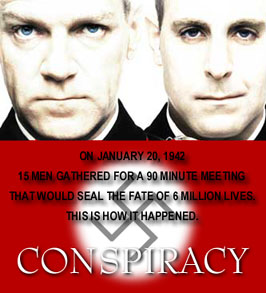
| "Conspiracy"
|
"They came to Wannsee as
high-ranking leaders of Germany's Nazi government. Two hours later, they left as
co-conspirators in the murder of millions of Jews. This is the story of the top-secret
Nazi meeting in which fifteen men debated--and ultimately agreed upon--the merits of
Hitler's "Final Solution," the extermination of the entire Jewish population of
Europe." - HBO What is most striking about this event is how much it resembles a common board room meeting at a corporation. The cold efficiency with which the decision to murder millions is made, is what is so profoundly chilling about it. Those at the meeting were more concerned with the quality of the food and wine, and made jokes about having a string quartet play music at the next meeting, than with the fact that they were agreeing to murder. Men of power make such cold decisions every day. This movie serves as a warning to consider the implications of seemingly casual decisions. For these men, this was less a matter of morality, than expedience. How often are other decisions made in government, which while not as overtly evil as genocide, are pursued with this same exact kind of situational ethics? How will history view those decisions? Also significant is the manipulation of language. Murder is termed "evacuation". Euphemisms are used to ease the mind into thinking that the horrendous is actually appropriate. Who is the "enemy"? Why? Again, the movie calls us to be mindful and wary of such manipulations today. |
||
| Books | |||
| Gimme Some Truth : The John Lennon FBI
Files by Jon Wiener Univ California Press
|
Book Review First a simple test. To whom was FBI Director, J. Edgar Hoover referring when he wrote to President Nixon's Chief of Staff, H.R. Haldeman, "[He is]...a paradox because he is difficult to judge by the normal standards of civilized life....His main reason for being is to destroy, blindly and indiscriminately, to tear down and provoke chaos...."? Adolf Hitler maybe, or some seminal Osama bin-Laden? Of course not, as you already know it was none other than our friendly, pudgy-faced, mop-headed, evil genius, that heinous John Lennon, composer of such bellicose anthems as "Imagine" and "Give Peace a Chance." Reason enough to warrant the FBI's surveillance of the man for 24 hours a day, for years on end? Well, not really, but they did it anyway. This book details the efforts by the author, Jon Wiener, and two ACLU attorneys, Mark Rosenbaum and Dan Marmalefsky, to obtain the 200 odd pages of documents held by the FBI on Mr. Lennon, that the agency had refused to release, (typically on grounds of either national security or ostensibly to protect confidential sources). To this end the attorneys employed the Freedom of Information Act (FOIA) as their basis to obtain these documents. The run-around that they were given by the government should be nothing new to students of previous such encounters, and the fact that it took 15 years to achieve it should not prove too surprising either. But without doubt the central point of this book, and one that cannot be overemphasized, is that it was the FBI (acting outside of its own charter and the explicit instructions contained in the FOIA) that violated the law, while finding no criminal activity on the part of Mr. Lennon. Possibly I'm too old, too jaded or just plain too cynical to be surprised to find out that the government, or its representatives, are capable of lying, placing illegal wire-taps, harassment, obfuscation and underhandedness. Certainly all of that happened here, and it is hats off to Rosenbaum and Marmalefsky for uncovering much of the skullduggery. Although most of the information on Mr. Lennon that was unearthed as a result of this effort was largely already known to any diligent reader of, for example, "Rolling Stone" magazine, following the trail of the hearings and legal arguments is a fascinating and worthwhile one, and the book's final chapter was (for me, at least) an eye-opener. — Nicholas Downey: June 4, 2000 |